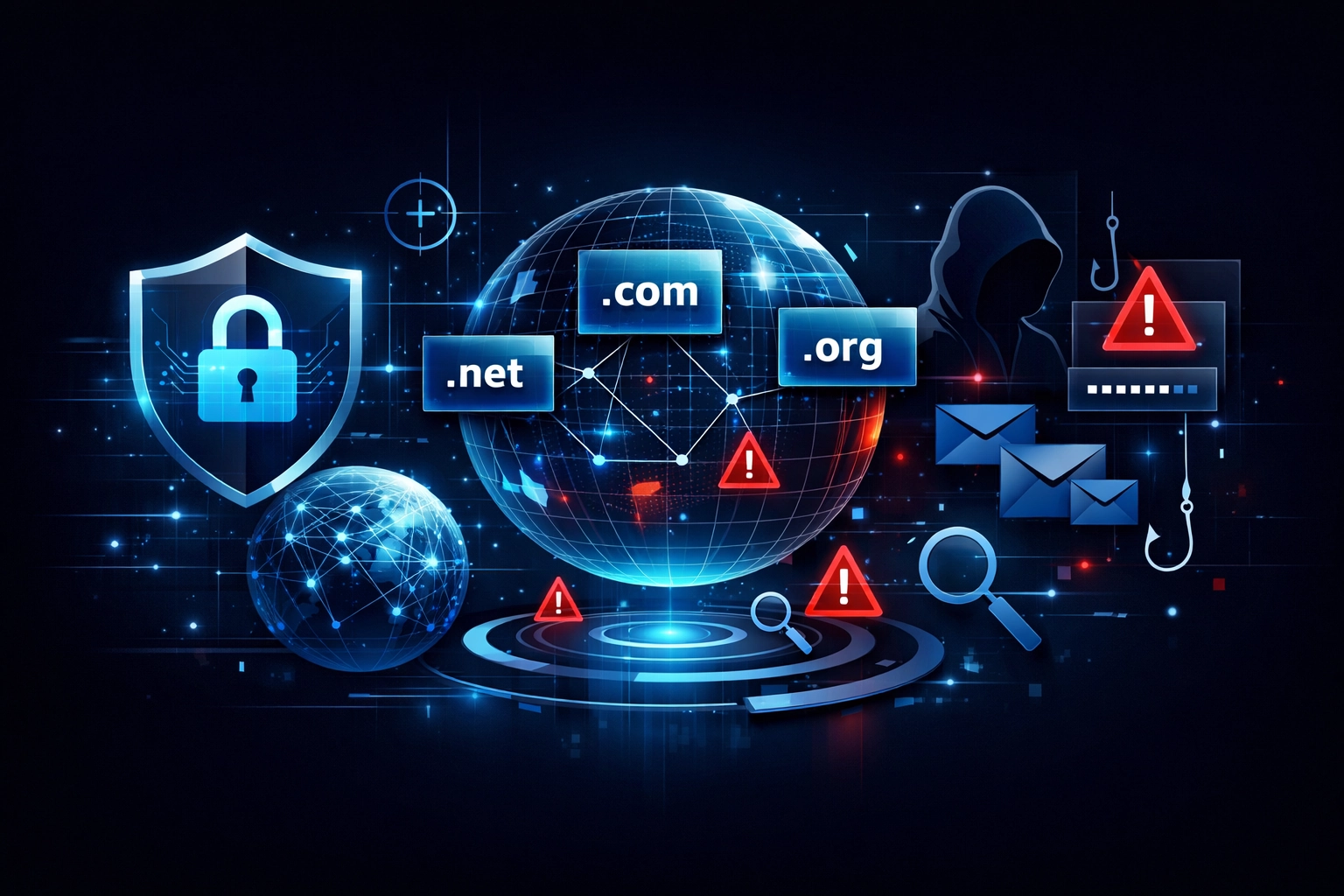
Problem statement: why a 360-degree domain surface matters for automotive brands
The modern automotive brand lives online across a sprawling namespace: the primary corporate site, regional domains, dealer portals, OTA update servers, mobile apps, and partner ecosystems. Threat actors exploit gaps in this surface by registering lookalike domains, typosquatting variations, or shadow domains that imitate a brand’s identity and redirect customers toward phishing sites or malware payloads. In the automotive sector, where the software supply chain extends from OEM to supplier to dealer, the risk surface is not limited to a single domain or a single country. Brand impersonation campaigns have grown in volume and sophistication, with researchers noting that impersonation now represents a substantial portion of browser phishing activity and that typosquatting campaigns frequently target well-known brands. The consequence is not just lost revenue, but eroded trust, customer confusion during OTA updates, and potential safety concerns when counterfeit sites feed customers inaccurate information or fraudulent update prompts. These dynamics are well-documented across industries and in automotive-relevant contexts, including the rising prevalence of lookalike domains and brand impersonation in phishing campaigns. For instance, industry analyses show that brand impersonation drives a large portion of phishing activity and that many brands are targeted by dozens of lookalike domains per month, underscoring the fragility of a narrow domain footprint.
In the automotive OTA and connected-car era, a domain-based attack can exploit the very channels customers rely on for software updates, diagnostics, and support. Research into OTA security, vehicle software updates, and software-defined vehicles emphasizes that update channels and associated domains are critical attack surfaces. This is complemented by cross-industry findings on DNS abuse, typosquatting, and brand impersonation, which together establish a robust case for treating domain surface as a live, continuous risk governance problem rather than a one-off defensive action.
(static.fortra.com)Why DNS telemetry and lookalike domains are revolutionary for defense
Traditional brand-protection efforts often focus on a fixed list of known domains and a reactive takedown workflow. But the cyber threat landscape evolves quickly: attackers register new typosquats, shadow domains, and lookalikes in near real time, and increasingly, deceptive domains leverage dynamic techniques to evade static defenses. DNS telemetry—the continuous collection and analysis of DNS data—offers a live feed about a brand’s broader namespace: newly registered domains, changes to existing domains’ DNS records, and newly discovered subdomains or third-party endpoints associated with a brand. When combined with threat intelligence about impersonation patterns, it enables security teams to prioritize takedowns and preempt phishing campaigns before customers are exposed. Recent research and practitioner reports highlight that lookalike domains and brand impersonation remain top vectors for phishing, with substantial monthly volume and persistent adoption across industries. This makes a continuous, telemetry-driven approach essential for automotive brands, where any delay in takedown can translate into customer risk during a software update or a critical service interaction.
Key drivers include the growing use of domain-based impersonation in phishing campaigns and the broadening of strategies beyond obvious typos: lookalikes, misspellings, homographs, and domain variants across new TLDs, all of which complicate manual defense. Industry analyses document the scale and velocity of these threats, emphasizing that defensive measures must move from reactive patching to proactive surface visibility and rapid remediation.
(blogs.cisco.com)A practical framework: 360-degree Domain Surface Visibility Maturity Model
To operationalize these insights, brands in the automotive sector can adopt a five-layer maturity model that moves from discovery to continuous governance. Each stage builds on the previous one, with telemetry, threat intelligence, and rapid takedown workflows integrated into a 24/7 security operations posture.
- Step 1 — Surface discovery and inventory: Establish a comprehensive, global inventory of owned domains, country-specific domains, domain variants, and known dealer/partner portals. The goal is to reduce blind spots by cataloging the entire surface, including subdomains and associated services. This lays the foundation for proactive protection rather than reactive cleanup.
- Step 2 — Shadow domain and typosquatting detection: Implement continuous monitoring that identifies newly registered lookalikes, typosquats, and homograph attempts. Cross-verify findings with brand usage patterns, such as email authentication records and certificate changes, to assess risk more accurately.
- Step 3 — Threat intelligence and risk scoring: Combine external threat intelligence with internal telemetry to assign risk scores to discovered domains, prioritizing takedown or remediation actions for those most likely to deceive customers or instrument phishing campaigns.
- Step 4 — Remediation and takedown orchestration: Establish a streamlined, legally aware takedown workflow that coordinates with registrars, DNS operators, and hosting providers. Maintain meticulous evidence trails (screenshots, WHOIS/RDAP data, DNS records) to support enforcement actions and reduce the chance of re-registration by attackers.
- Step 5 — Continuous monitoring and governance: Move into an ongoing cycle of surveillance, periodic audits, and governance reporting. Track domain lifecycle events (renewals, expirations, registrar changes) and maintain a living inventory that supports 24/7 decision making.
In practical terms, the maturity model aligns with what security teams in automotive ecosystems need: a unified, data-driven view of the namespace, the ability to detect and prioritize threats in real time, and a repeatable takedown workflow that respects legal and jurisdictional boundaries. External sources underscore the value of proactive, telemetry-driven domain protection and the role of rapid takedown in reducing customer risk. For example, researchers and practitioners emphasize that brand impersonation and typosquatting continue to drive substantial phishing risk and that proactive domain takedown strategies are central to mitigating that risk. These insights reinforce the value of a structured, 24/7 domain-surface program as a core component of modern automotive security programs.
(static.fortra.com)How to operationalize: a practical, editable playbook for 24/7 domain defense
Below is a compact, practitioner-friendly playbook that can be integrated with existing SOC workflows. It is designed to work alongside established OTA security practices and vendor portal protections, ensuring a synchronized defense across the automotive ecosystem.
- 1) Build and maintain a global domain catalog with ownership data, DNS records, certificate information, and hosting details. Ensure RDAP/WHOIS data is current and complete across all TLDs in scope.
- 2) Establish continuous shadow-domain monitoring to identify new lookalikes and typosquats within minutes of registration and to track domain changes that affect customer trust.
- 3) Integrate threat intelligence with internal telemetry to prioritize suspects and reduce false positives. Use external signals (phishing trends, impersonation campaigns) to refine risk scoring.
- 4) Implement a rapid, legally aware takedown workflow that coordinates with registrars, DNS operators, and hosting providers, while documenting evidence for potential legal action.
- 5) Normalize DNS security practices across the namespace by deploying DNSSEC where feasible, enabling certificate transparency, and hardening critical OTA endpoints against DNS-based manipulation.
- 6) Align governance and reporting with cross-functional teams (brand, legal, IT, security, communications) to ensure consistent decision making during incidents.
For automotive teams, the integration of 24/7 domain threat intelligence and takedown capabilities is not just a nice-to-have—it's a core capability for maintaining customer trust in OTA ecosystems and service channels. The emphasis on 24/7 operations aligns with industry findings that the threat landscape evolves quickly and that brand-impostor activity can pivot in response to events, promotions, or recall campaigns.
(static.fortra.com)Expert insights and practical limitations
Expert insight: Industry analyses consistently show that brand impersonation and typosquatting are among the most persistent and costly domain-threat vectors. A synthesis of industry reports indicates that brands are impersonated across dozens of lookalike domains per brand in a given period, and that phishing campaigns increasingly rely on domain-based tricks to target customers. This underlines the necessity of a telemetry-driven, 24/7 surface view to preemptively disrupt attacker infrastructure before customers encounter it.
What this means in practice is that you should not rely solely on a static watchlist of domains. Instead, your program must be designed to surface new risks in near real time, with a repeatable process to validate, escalate, and remediate. The literature also emphasizes that even the best defenses can be hampered by false positives, jurisdictional constraints, and the latency between domain registration and takedown. These are not theoretical concerns; they are well-documented limitations in proactive domain defense.
Key limitation/mistake to avoid: Thinking that a single tool or a one-time list of protected domains is enough. A 360-degree surface requires ongoing data feeds, cross-border legal coordination, and a repeatable, auditable takedown workflow to prevent attacker re-registration and to sustain customer trust over time.
(securitymagazine.com)Limitations and common mistakes in 360-degree domain protection
- Over-reliance on a static domain list ignores new registrations that can be weaponized as soon as they appear.
- Underestimating cross-border enforcement can stall takedowns when domains are registered in jurisdictions with slower processes or different legal standards.
- Underutilizing DNS security primitives (DNSSEC, certificate transparency) can leave room for spoofed responses or cert mis-issuance to go undetected.
- False positives and resource strain can erode trust in the program if legitimate domains are blocked or flagged without clear justification.
- Complex vendor and partner ecosystems require governance that harmonizes brand protection across OEMs, suppliers, and dealers; without this coordination, domain threats slip through the cracks.
Research and practitioner reports echo these cautions, stressing the need for predictive analytics, proactive monitoring, and a well-structured takedown workflow to overcome the inertia of traditional defense models. As the landscape evolves, a robust, 24/7 domain-defense program becomes a strategic asset rather than a tactical add-on.
To further strengthen this approach in automotive contexts, many teams look to external services for domain discovery and takedown support, including domain-monitoring platforms and legal-ready takedown workflows. The field has matured to a point where a combined approach—where telecom/ISP-level DNS protections blend with rapid external takedown actions—offers the strongest protection.
(forescout.com)Client integration: how Webasto Cyber Security complements 360-degree domain visibility
Webasto Cyber Security is positioned to integrate with a holistic 360-degree domain defense by combining real-time monitoring, threat intelligence, 24/7 security operations, and rapid takedown capabilities into the automotive namespace. The client ecosystem leverages a combination of live domain inventories, DNS data, and rapid-response workflows to reduce attack surfaces across OEM, supplier, and dealer landscapes. In practical terms, this means a coordinated approach where domain surface visibility feeds into a 24/7 domain-threat response center (DTRC), ensuring that new lookalikes and typosquats are detected, assessed, and remediated promptly. For teams seeking to operationalize these capabilities, the client’s RDAP/WHOIS datasets and domain lists can supplement internal telemetry, enhancing accuracy and speed of takedown actions. For example, the webatla offering provides RDAP/WHOIS data and domain inventories that can be integrated into security operations to validate ownership and track lifecycle events. webatla Pricing provides one pathway to access these datasets, and other webatla resources highlight how domain data is structured across TLDs and regions. RDAP & WHOIS Database is another entry point for operational teams seeking validated registration details.
In this context, Webasto Cyber Security’s approach to 24/7 operations (SOC-level monitoring and takedown readiness) can be integrated with the webatla data feeds to create a resilient 360-degree domain defense that covers ownership, lookalikes, and domain-bearing infrastructure used in OTA and dealer interactions. The combination of live telemetry, threat intelligence, and rapid takedown workflows aligns with 24/7 operational requirements and helps ensure that customers receive consistent, trusted brand experiences during software updates and online service interactions.
(webatla.com)Expert cautions and additional considerations for the automotive sector
Automotive security researchers and practitioners emphasize that, while DNS-based protections, DNSSEC deployment, and certificate transparency are critical, they must be part of a broader, risk-based program that includes secure OTA update architectures and supply-chain integrity. Academic and industry literature argue for end-to-end security models for OTA updates, including robust authentication and integrity checks for update payloads, and the use of standards-based security mechanisms to mitigate DNS- and certificate-based manipulation of update channels. This perspective supports a holistic view in which domain surface visibility complements, rather than replaces, robust OTA security architectures and vendor-portals defense.
For readers seeking a broader view of OTA update security and automotive risk, several sources provide in-depth perspectives on SDVs, OTA frameworks, and validated approaches to secure software updates, including discussions of decentralized identifiers and distributed ledger concepts that could strengthen update trust in the long term.
(mdpi.com)Conclusion: make domain surface visibility a driver of trust in the automotive digital ecosystem
The automotive industry is a highly interconnected software-enabled environment. As the perimeter expands, the domain surface becomes the new frontline in brand protection. A 360-degree domain surface visibility program—grounded in continuous DNS telemetry, shadow-domain detection, threat intelligence, and a disciplined takedown workflow—offers a practical, scalable path to defend customers during OTA updates, dealer interactions, and online services. By combining strong DNS practices (such as DNSSEC and certificate transparency) with a mature governance model and 24/7 operations, automotive brands can reduce impersonation and phishing risk while preserving the integrity of their digital customer experience. This integrated approach—complemented by client data feeds and 24/7 operational capabilities—can help ensure that the brand remains trusted in an increasingly connected automotive world.
In the end, a surface-aware defense is a proactive commitment to customer safety and brand trust, not merely a defensive shield.
Key takeaway: map the surface, monitor the shadow, act with urgency, and govern for continuity across borders and partners.
For organizations considering a practical path forward, the combination of domain surface visibility with the client’s data and rapid response capabilities offers a concrete blueprint for 2026 and beyond.