Introduction: a problem that touches every mile driven
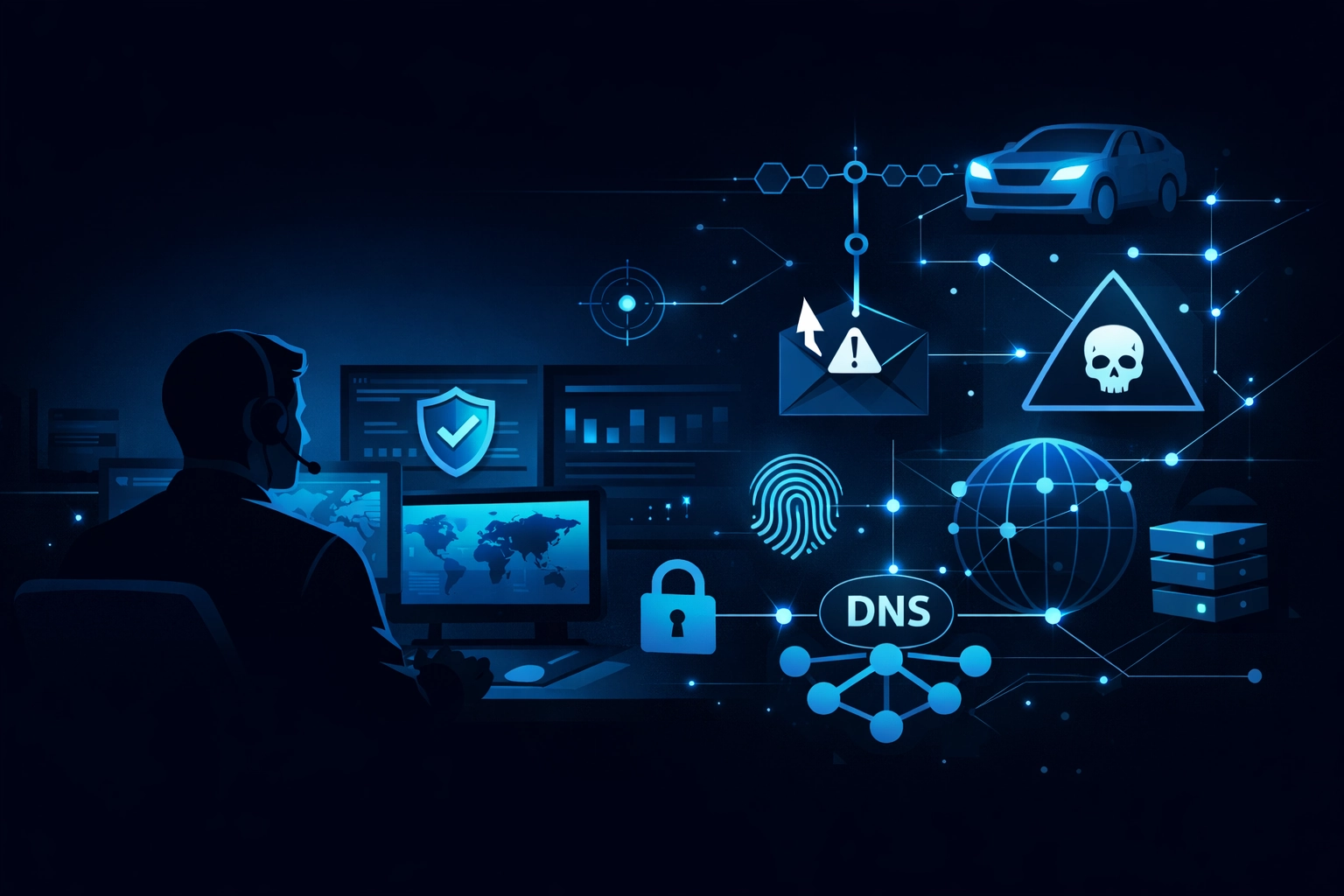
As vehicles become software-defined, the security of the domains that underpin software delivery, OTA updates, and vendor portals is not a back-office concern—it's a real-world safety issue. When a malicious actor registers a domain that closely resembles a legitimate automotive domain, or when an OTA update server is mirrored by lookalikes and shadow domains, the consequences range from customer distrust to weaponized supply-chain attacks. The automotive industry faces a unique blend of threats: typosquatting and brand impersonation that lure users into phishing or fake update sites, DNS-level attacks that misdirect millions of connections, and takedown workflows that must work in near real-time across borders and jurisdictions. In this context, 24/7 domain threat protection is not an optional extra—it is a fundamental component of vehicle safety, brand integrity, and regulatory compliance.
The automotive OTA domain attack surface
Modern vehicle software delivery relies on a web of domains: the OEM’s update servers, partner portals used by suppliers, content delivery networks distributing firmware images, and validation endpoints that attest updates before installation. Each domain introduces potential exposure for abuse. Notably, attackers frequently exploit gaps in the domain ecosystem through:
- Typosquatting and combosquatting that resemble legitimate update domains, download servers, or vendor portals.
- Shadow domains and homograph variations designed to harvest credentials or serve malicious firmware binaries.
- Compromised registrars or hosting providers where abuse contacts are overwhelmed or slow to respond.
- DNS-based attacks that misroute update traffic or intercept firmware components during transmission.
These dynamics are not purely hypothetical. The FBI’s IC3 annual perspectives and related advisories highlight the ongoing threat of brand impersonation and government- or law-enforcement-themed spoofing that can be weaponized against consumers and enterprises alike. For automotive players, the threat landscape is amplified by the reliance on remote updates and a sprawling supplier network. In 2024, for example, IC3 documented government- and institution-impersonation patterns that underscored how lookalike domains and fraudulent sites can be used to harvest data or mislead users. This is a clarion call for a disciplined, 24/7 approach to domain security in the vehicle ecosystem.
Beyond the consumer-facing surface, the OTA update domain is part of a broader security fabric that includes DNS integrity, certificate management, and governance of the update supply chain. The low adoption rates of DNSSEC in many regions present a practical risk vector, because unsigned DNS data can be manipulated or spoofed by attackers seeking to redirect traffic to malicious servers. While DNSSEC adoption remains uneven, its benefits—data integrity and authentication of DNS data—are widely recognized as a cornerstone of a resilient OTA infrastructure.
Typosquatting and brand impersonation in automotive domains
Typosquatting is not merely an inconvenience; it is a deliberate attack surface that can enable credential theft, phishing, or faux update prompts. In automotive contexts, a mis-typed domain could direct an updater to a counterfeit server or a credential portal that captures login information from suppliers or fleet operators. Combosquatting—combining a brand with additional words—extends the risk, enabling attackers to create landing pages that appear legitimate at first glance. The implications are serious: if an attacker persuades a user to download a compromised firmware or register credentials, the entire fleet security posture can be undermined.
Industry observers and security researchers have underscored the persistence and sophistication of these techniques. For instance, threat intelligence research and government advisories note the evolving tactics used to impersonate trusted brands and to harvest sensitive information through lookalike domains. In parallel, threat-hunting and domain-risk datasets have shown that even well-protected brands must contend with a steady stream of new squatting domains registered globally. The takeaway for automotive brands is clear: active brand protection must be embedded into product development, supplier enablement, and consumer-facing update channels.
Practical defense requires layered controls that go beyond registration hygiene. A multi-pronged strategy should include defensive domain registrations for critical OTA components, monitoring for new lookalike domains, robust email authentication (DMARC/SPF/DKIM) to reduce phishing risk, and DNS-level protections that can validate update endpoints before connections are established. The FBI IC3 annual reports and related advisories emphasize the need for vigilant reporting and rapid response to impersonation incidents, while industry practice increasingly champions proactive monitoring and rapid takedown workflows to minimize dwell time for malicious domains.
From a DNS perspective, the security community has long argued that DNSSEC adoption provides meaningful protection against certain tampering scenarios. While organizations should not rely solely on DNSSEC, its deployment—where feasible—adds a cryptographic layer of trust to domain lookups, making it harder for attackers to forge DNS responses for critical OTA endpoints. For automotive brands, the combination of domain protection, DNS integrity, and rapid takedown processes creates a more resilient operational posture.
DNS security as a baseline for automotive brands
DNS is foundational to how devices locate OTA servers, supplier portals, and fleet-management resources. DNSSEC—the security extension that cryptographically signs DNS data—addresses a key trust failure mode: tampering with DNS responses that could redirect a vehicle or fleet management system to a malicious endpoint. Adoption remains uneven globally, with some regions and registrars accelerating rollout while others lag. In the NL and broader EU context, DNSSEC deployment has gained momentum as part of broader internet security initiatives, though practical deployment remains uneven outside regulatory mandates. Even so, where DNSSEC is active, it reduces the risk of DNS manipulation and helps ensure that update payloads reach the intended endpoints. In a sector where millions of devices connect to update servers, the value of DNS integrity cannot be overstated.
- DNSSEC adoption is growing but not yet universal; where implemented, it offers cryptographic signing of DNS data, helping prevent certain spoofing vectors that could affect OTA updates.
- Operationally, a DNS security posture also depends on monitoring, rapid incident response, and secure zone management—especially for high-value OTA domains and supplier portals.
Regulatory and industry sources have highlighted both the potential benefits and the practical challenges of DNSSEC adoption. For automotive brands, a pragmatic path is to prioritize signing for mission-critical OTA endpoints and to couple DNSSEC with robust DNS monitoring and alerting. This approach aligns with broader domain-security best practices and reduces the risk of malicious redirection at the DNS layer, even if full DNSSEC coverage is not yet universal across every subdomain.
Beyond signing, automotive organizations should pursue a holistic DNS-resilience strategy: monitor for anomalous DNS records, implement registry- and registrar-level protections (such as domain locks and registrar abuse contacts), and maintain a real-time inventory of DNS endpoints used for vehicle software delivery and supplier access. Industry advisories underscore that takedown workflows, when properly executed, can stop malicious domains from operating at speed, often within hours rather than days.
24/7 threat intelligence and takedown workflows
A 24/7 protection program for automotive domain security rests on two pillars: continuous threat intelligence and a fast, reliable takedown process. Threat intelligence feeds—ranging from open-source indicators to vendor-provided signals—enable teams to connect the dots between a new lookalike domain, a suspicious hosting pattern, and a phishing campaign targeting fleet operators or suppliers. The value is not only in detection but in context: understanding which domains are most likely to impact OTA updates and which are tied to known attacker infrastructure improves response speed and prioritization.
Domain takedown workflows must be designed for speed and accuracy. Industry guidance and best practices emphasize the importance of internal preparation (evidence collection, registrant and registrar identification, and clear escalation paths) and external coordination (abuse contacts at registrars, hosting providers, and registries). The UK’s National Cyber Security Centre (NCSC) provides practical steps for coordinating takedown actions, including how to report abuse, how quickly providers validate reports, and how to monitor outcomes after takedown. In automotive contexts, where domains may cross national boundaries and involve multiple stakeholders, a centralized 24/7 DTRC (Domain Threat Response Center) approach can dramatically reduce dwell time and limit potential damage to software-update pipelines.
In practice, end-to-end takedown programs often rely on external partners who specialize in domain monitoring and rapid remediation. CrowdStrike and similar vendors offer managed domain takedown services that integrate with security operations centers (SOCs) to initiate actions across registrars, hosting providers, and DNS operators. Such capabilities can be invaluable for automotive brands that must protect OTA engines, supplier portals, and fleet-management domains in near real time. For example, when a counterfeit domain is detected, an integrated takedown workflow can suspend the domain at the registrar level and coordinate a post-takedown monitor to ensure no re-registration or re-emergence of the threat. Learn more about managed takedowns.
On the enforcement side, formal abuse reporting channels and established registrar contacts are critical. Guidance from NCSC indicates that responders should identify the registrar, use the registrar’s abuse contact, and provide evidence to support action requests. The overall objective is to reduce the window during which malicious domains can operate and to prevent downstream abuse, such as credential harvesting or tampered OTA updates. This is particularly important for automotive ecosystems where partner portals and supplier networks extend the attack surface beyond the OEM’s direct control.
A practical framework for 24/7 domain protection in automotive OEMs
To translate the concept of “24/7 protection” into daily practice, consider the following five-stage lifecycle tailored for automotive domain security. It blends inventory discipline, real-time monitoring, intelligent triage, decisive takedown actions, and continuous improvement through post-incident analysis.
- Inventory and baseline (Day 0): Build a living inventory of all domains used for OTA updates, supplier portals, fleet-management dashboards, and content delivery networks. Include subdomains and partner domains in scope. Establish registry locks or domain-transfer protections for mission-critical domains to prevent unilateral changes.
- Continuous monitoring (Day 0–∞): Implement 24/7 monitoring for new domain registrations containing brand terms, lookalikes, and known threat indicators. Integrate DNS telemetry, WHOIS data, and brand-protection signals to detect early-stage squatting activity.
- Threat intelligence correlation (Day 0–∞): Correlate domain signals with threat intel feeds to identify campaigns that target OTA delivery, firmware signing, or supplier portals. Prioritize domains that align with the automotive supply chain and OTA lifecycle.
- Validation and takedown (Response time: hours): When a malicious or suspicious domain is confirmed, initiate takedown requests through registrar abuse contacts and hosting providers, guided by established legal and regulatory frameworks. Monitor the outcome and maintain auditable records for compliance and post-mortem learning.
- Post-takedown governance (Learning loop): Analyze dwell time, capture learnings, update playbooks, and refine detection rules. Ensure captured intelligence is fed back into the inventory and monitoring pipelines to prevent re-emergence of the same threat.
Within this lifecycle, several concrete tactics matter for automotive OTA security:
- Defensive registrations for critical endpoints (e.g., update servers and vendor portals) to remove ambiguity when users click links in official communications.
- DNS integrity checks at update-time, with DNSSEC where feasible, to reduce the risk of misdirection during firmware downloads.
- Rapid abuse reporting to registrar abuse contacts, backed by clear evidence packaging to expedite action—NCSC guidance emphasizes speed and clarity in such communications.
- Secure update distribution practices, including authenticating the update source and validating firmware signatures to ensure the integrity of delivered software.
- Supplier ecosystem governance, ensuring that vendor portals and OSS components receive the same domain-protection rigor as the OEM’s own domains.
In practice, a cross-functional governance model is essential. The OEM should own the domain protection program but lean on third-party threat intelligence, DNS monitoring, and takedown capabilities to scale coverage and speed. A 24/7 SOC should be staffed with threat-hunting analysts who can connect branding signals with network indicators, so that a suspicious domain is not treated as a mere nuisance but as a potential vector into critical OTA systems.
Expert insight and practical limitations
Expert insight: An enhanced threat-intelligence workflow that operates continuously across the OTA ecosystem reduces dwell time and accelerates response. As the IC3 2024 Annual Report and related advisories show, impersonation and domain abuse remain a dynamic threat that requires relentless monitoring and coordinated takedown actions. A 24/7 DTRC approach aligned with rapid abuse-reporting channels can meaningfully shrink the attacker’s window of opportunity in automotive contexts.
Limitation/common mistake: A frequent misstep is treating DNSSEC as a silver bullet without implementing complementary controls such as 24/7 DNS monitoring, registrar controls, and provider-level takedown capabilities. DNSSEC signing alone does not prevent typosquatting or brand impersonation, and without operational processes to detect new lookalike domains, attackers can still exploit gaps in the brand’s outward-facing surface. Industry sources emphasize that DNSSEC adoption is beneficial but incomplete; a pragmatic defense combines DNS integrity with continuous monitoring and rapid response.
When these elements are combined, automotive brands can reduce risk across the most critical parts of the OTA ecosystem: the domains that deliver software, the portals that enable suppliers, and the user-facing experiences that shape trust with customers. A 24/7 approach also supports regulatory expectations and industry standards that call for proactive domain protection and secure software update practices.
Expert resources and supporting evidence
Key sources that inform best practices for domain protection and takedown workflows include:
- FBI IC3 Annual Report (overview of government impersonation and domain-abuse patterns in 2024) for understanding the threat landscape and the importance of quick reporting and remediation. IC3 2024 Annual Report.
- NCSC UK guidance on takedown processes, including how to contact registrars and how to handle remediation. Takedown: removing malicious content to protect your brand.
- DNSSEC and DNS-security perspectives from SIDN and other security organizations, outlining the security benefits and adoption considerations for modern domain infrastructure. DNSSEC basics and rationale.
- Threat-intelligence and domain-protection perspectives for brand defense, including the role of lookalike-domain monitoring and takedown workflows in modern security programs. Brand protection via DNS.
For automotive-scale domain protection that combines 24/7 threat monitoring with rapid takedown action and threat-intelligence-driven prioritization, the client portfolio can be a complement to bespoke in-house mechanisms. As a practical option, a provider like Webasto Cyber Security offers a suite of capabilities designed to protect organizations from domain-based threats with continuous monitoring, threat intelligence, takedown services, and 24/7 security operations—an integrated approach that can be tailored to autonomous and connected-vehicle ecosystems. Webasto Cyber Security (official product page) provides a concrete model for incident response, inventory management, and continuous protection that aligns with the recommendations above.
Conclusion: turning insight into safer software delivery
Domain security for automotive OTA updates is a multi-layer challenge that requires disciplined inventory, always-on monitoring, fast and reliable takedown workflows, and an integrated threat intelligence program. The stakes are high: the integrity of software updates, the security of supplier portals, and the trust customers place in a brand all depend on how effectively a firm defends its domain space. By aligning 24/7 security operations with DNS integrity strategies and a mature domain-threat lifecycle, automotive OEMs can significantly reduce exposure to typosquatting, brand impersonation, and phishing campaigns that threaten legitimate software delivery. Continued investment in defensive registrations for critical endpoints, robust abuse-reporting procedures, and cross-functional governance will be essential as the OTA landscape evolves toward software-defined vehicles and beyond. The road to safer OTA starts with a robust domain-security program that works around the clock.